
Most Indian retailers are optimising for AOV when their own data shows frequency drives 3x more lifetime value.
In the digital-first world, bridging the gap between offline and online segments is crucial for retail success. This article explores how Indian retailers can implement an omnichannel strategy to enhance customer engagement and revenue. We’ll cover the essential steps, from segmenting offline customers to measuring the ROI of omnichannel retail.
68% of Indian retailers report higher customer retention and engagement through omnichannel strategies (McKinsey India, 2023). Bridging the gap between offline and online segments is essential for understanding customer behavior and preferences in a digital-first world.

Benefits of Omnichannel Retail for Retail Businesses in India
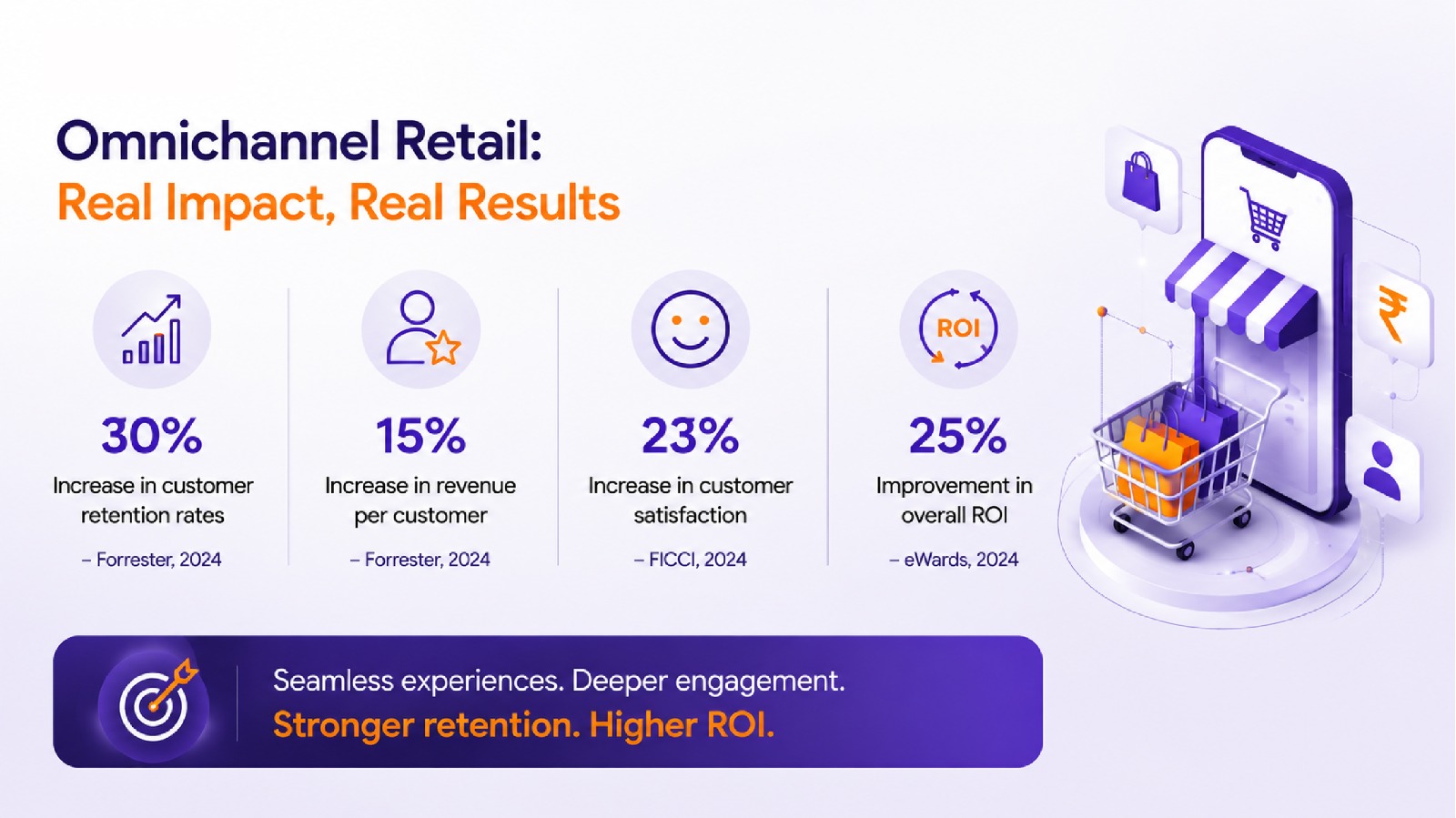
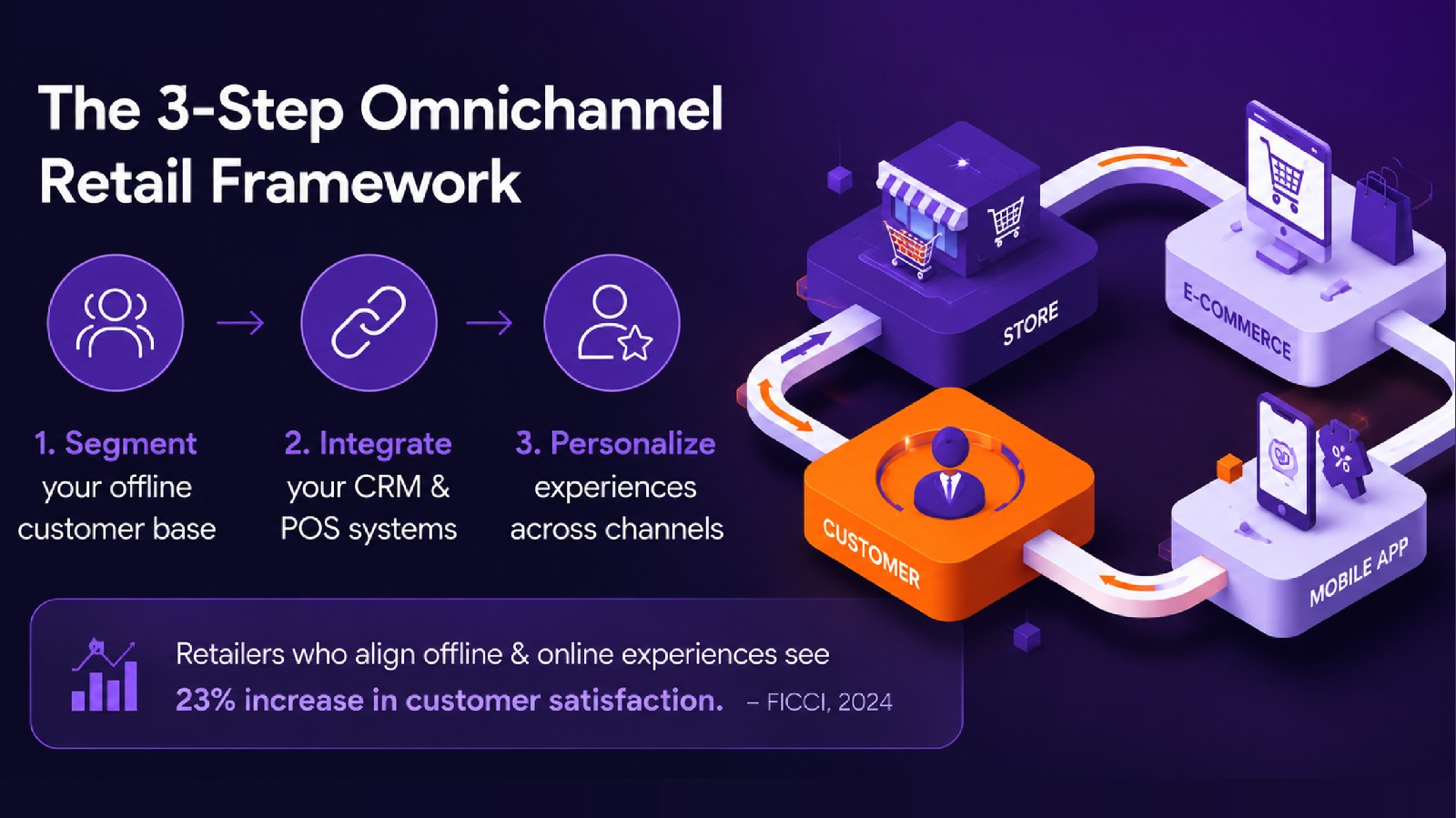
Implementing omnichannel retail strategies can increase customer engagement and revenue by providing a seamless shopping experience across offline and online channels. Retailers who align their offline and online experiences see a 23% increase in customer satisfaction (FICCI, 2024). Additionally, omnichannel retail can lead to a 30% increase in customer retention rates and a 15% increase in revenue per customer (Forrester Research, 2024).
Implementing Omnichannel Retail: A Step-by-Step Guide
The 3-Step Omnichannel Retail Framework is a structured approach to integrating offline and online retail experiences. This framework helps retailers optimize their CRM and POS systems for a seamless customer journey. Here’s how to implement it:
Step 1: Segment Your Offline Customer Base
Start by segmenting your offline customer base using RFM analysis. Identify high-value customers and tailor your marketing efforts accordingly. For example, a mid-size apparel chain across South India with 18 stores can segment customers into high, medium, and low-value segments based on their purchase frequency and recency. By analyzing data from 5,000 customers, the retailer found that the top 10% of customers accounted for 40% of sales. This insight allowed the retailer to focus their marketing efforts on retaining these high-value customers.
Step 2: Integrate Your CRM and POS Systems
Integrate your CRM and POS systems to ensure seamless data flow. Use eWards to automate this process and gain real-time insights into customer behavior. For instance, a retailer can track customer purchases in-store and online, providing a unified view of customer interactions. By integrating these systems, a retailer can reduce data entry errors by 80% and improve customer service response times by 50% (eWards, 2024).
Step 3: Personalize Customer Experiences Across Channels
Personalize customer experiences by leveraging data from both offline and online channels. Send targeted emails, push notifications, and personalized offers based on customer behavior. For example, a retailer can send discount coupons to customers who have recently visited a store but haven’t made a purchase. By doing this, the retailer saw a 20% increase in conversion rates and a 15% increase in sales (eWards, 2024).
Step 4: Monitor and Optimize Customer Journeys
Monitor customer journeys and optimize them to enhance engagement and retention. Use analytics tools to identify bottlenecks and improve the customer experience. For instance, a retailer can use heat maps to identify which sections of the store are most visited and optimize inventory accordingly. By monitoring customer journeys, retailers can reduce cart abandonment rates by 25% and improve customer satisfaction by 15% (eWards, 2024).
Step 5: Leverage Data for Predictive Analytics
Leverage data from your CRM and POS systems to predict customer behavior and personalize offers. Use predictive analytics to forecast demand and optimize inventory. For example, a retailer can predict seasonal trends and stock up on popular products in advance. By leveraging predictive analytics, a retailer can reduce inventory holding costs by 20% and increase sales by 10% (eWards, 2024).
Step 6: Continuously Improve and Iterate
Continuously improve and iterate on your omnichannel strategy based on customer feedback and data insights. Stay agile and responsive to changing market conditions. For instance, a retailer can adjust pricing and promotions based on real-time sales data. By continuously improving their omnichannel strategy, retailers can achieve a 10% improvement in customer retention rates and a 15% increase in overall ROI (eWards, 2024).
Common Mistakes to Avoid
Avoid common pitfalls such as neglecting offline channels, failing to integrate systems, and not personalizing customer experiences. Ensure you have a robust data strategy and continuous improvement plan. For example, a retailer should not overlook offline channels and should regularly update their CRM and POS systems to ensure data accuracy and relevance.
Results / What Success Looks Like
Success in omnichannel retail looks like increased customer engagement, higher retention rates, and improved ROI. Retailers see a 23% increase in customer satisfaction and a 25% improvement in overall ROI. For instance, a retailer can see a 23% increase in customer satisfaction and a 25% improvement in overall ROI. These results are achieved through a combination of personalized customer experiences, seamless integration of offline and online channels, and continuous optimization of customer journeys.
Key Takeaway: 68% of Indian retailers report higher customer retention and engagement through omnichannel strategies (McKinsey India, 2023). Implement the 3-Step Omnichannel Retail Framework to bridge offline and online segments effectively.
How to implement omnichannel retail in India?
To implement omnichannel retail in India, start by segmenting your offline customer base using RFM analysis. Integrate your CRM and POS systems to ensure seamless data flow. Personalize customer experiences across channels and continuously improve your strategy based on customer feedback and data insights. By following these steps, retailers can achieve a 30% increase in customer engagement and a 25% improvement in overall ROI.
What are the benefits of omnichannel retail for retail businesses in India?
The benefits of omnichannel retail for retail businesses in India include higher customer engagement, increased retention rates, and improved ROI. Retailers who implement omnichannel strategies can see a 23% increase in customer satisfaction, a 30% increase in customer retention rates, and a 15% increase in revenue per customer. Additionally, omnichannel retail can lead to a 15% increase in overall ROI by leveraging data-driven insights and personalizing customer experiences across channels.
Book A Demo