
India has officially entered a new era of data governance. With the Ministry of Electronics and Information Technology (MeitY) notifying the Digital Personal Data Protection (DPDP) Rules 2025, the Digital Personal Data Protection Act 2023 is now fully operational. This marks a major milestone as India’s first comprehensive framework dedicated to protecting digital personal data.
For businesses across Retail and F&B, the DPDP Act is more than just another compliance requirement. It lays down clear obligations for every entity handling customer data and defines the rights and duties of individuals whose data is being collected. In simple terms, the law now sets the rulebook for how brands can store, use, and secure personal information in a digital-first world.
For consumer-facing businesses especially, this framework is a chance to strengthen customer trust, enhance transparency, and ensure long-term loyalty through responsible data handling.
Before we dive deeper, it’s important to understand two key terms used repetitively in the DPDP framework:
- Data Principal: The individual to whom the personal data belongs, i.e., the customer whose information is being collected or processed.
- Data Fiduciary: The entity that decides the purpose and method of processing this data such as a business, organisation, or service providers.
With these fundamentals in place, let’s explore what the DPDP rules mean specifically for the Retail and F&B sectors, and how brands can prepare for the road ahead.
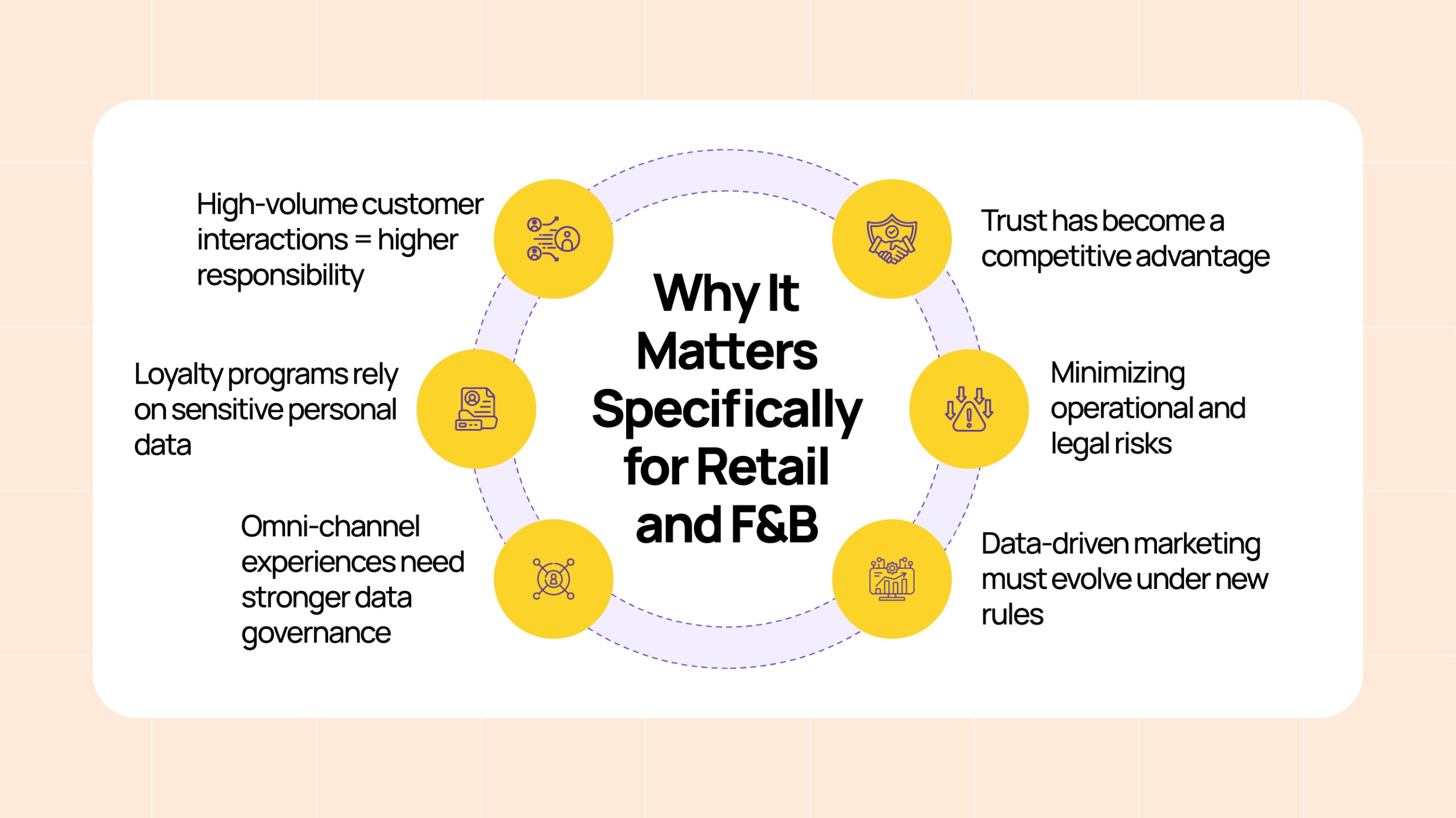
Why It Matters Specifically for Retail and F&B
Retail and F&B businesses handle some of the richest and most sensitive forms of customer data every single day from mobile numbers, birthdays, purchase history, payment information, preferences, feedback, to more. This data fuels everything from loyalty programs to personalized offers, home delivery, reservations, and post-purchase engagement. Because the sector depends heavily on customer insights and repeat business, data has become a core operational asset.
This is exactly why the DPDP 2025 framework carries significant weight for Retail and F&B:
1. High-volume customer interactions = higher responsibility
Stores, cafés, restaurants, and QSR chains engage with thousands of customers daily across POS systems, websites, delivery apps, and CRM platforms. With so many touchpoints collecting personal data, businesses must ensure every channel is secure, compliant, and transparent.
2. Loyalty programs rely on sensitive personal data
Loyalty programs are one of the biggest data engines in these sectors. They require continuous collection of personal information to personalize benefits. Under DPDP, brands must obtain clear consent, maintain clean data practices, and ensure customers understand how their information is being used.
3. Omni-channel experiences need stronger data governance
Retail and F&B today operate across physical stores, apps, WhatsApp, social media, e-commerce, aggregators, and in-store systems. DPDP demands centralized governance and consistent compliance across all channels no matter where the data comes from or where it flows next.
4. Trust has become a competitive advantage
Customers are becoming more aware and cautious about how brands use their data. Transparent practices not only ensure compliance but also build long-term trust. For businesses where customer loyalty drives revenue, strong data protection can directly impact retention and brand perception.
5. Minimizing operational and legal risks
Non-compliance can lead to penalties, reputational damage, and disruptions in customer engagement workflows. For sectors that depend on daily footfall and repeat consumption, even temporary loss of customer trust can lead to significant revenue impact.
6. Data-driven marketing must evolve under new rules
CRM-driven marketing like reactivation flows, campaign automation, and personalization will need to be aligned with the new consent and governance requirements. Brands that adapt early will secure a smoother transition and maintain uninterrupted engagement.
Key Rules Introduced Under DPDP 2025

The DPDP Rules 2025 lay down a clear and actionable framework that every business handling personal data must follow. Here are the most important rules you need to know:
1. Verifiable Parental Consent for Children’s Data
Companies must obtain verifiable, reliable consent from a parent or guardian before processing the personal data of children.This includes verifying adult identity using trusted methods such as identity details or virtual tokens. This rule ensures minors are fully protected from improper data use.
2. Immediate Intimation in Case of a Personal Data Breach
Companies must inform users without delay if their personal data has been compromised.
They must clearly communicate:
- What happened
- What data was affected
- What risks users may face
- What safeguards are now being implemented
This ensures customers are never left in the dark during a breach and can take timely action.
3. Restrictions on Transferring Certain Data Overseas
Personal data can be transferred outside India, but the Central Government can impose restrictions through specific orders (for certain data or destinations).
Retail & F&B brands using global CRM tools, cloud platforms, or analytics systems must ensure their data storage and processing comply with these restrictions.
4. Establishment of a Digital-First Data Protection Board (DPB)
A new regulatory body, the Data Protection Board, must be established as a fully digital institution.
It will allow citizens to:
- File complaints online
- Track the resolution process
- Access the system through a dedicated app or portal
This ensures faster grievance handling and greater accountability.
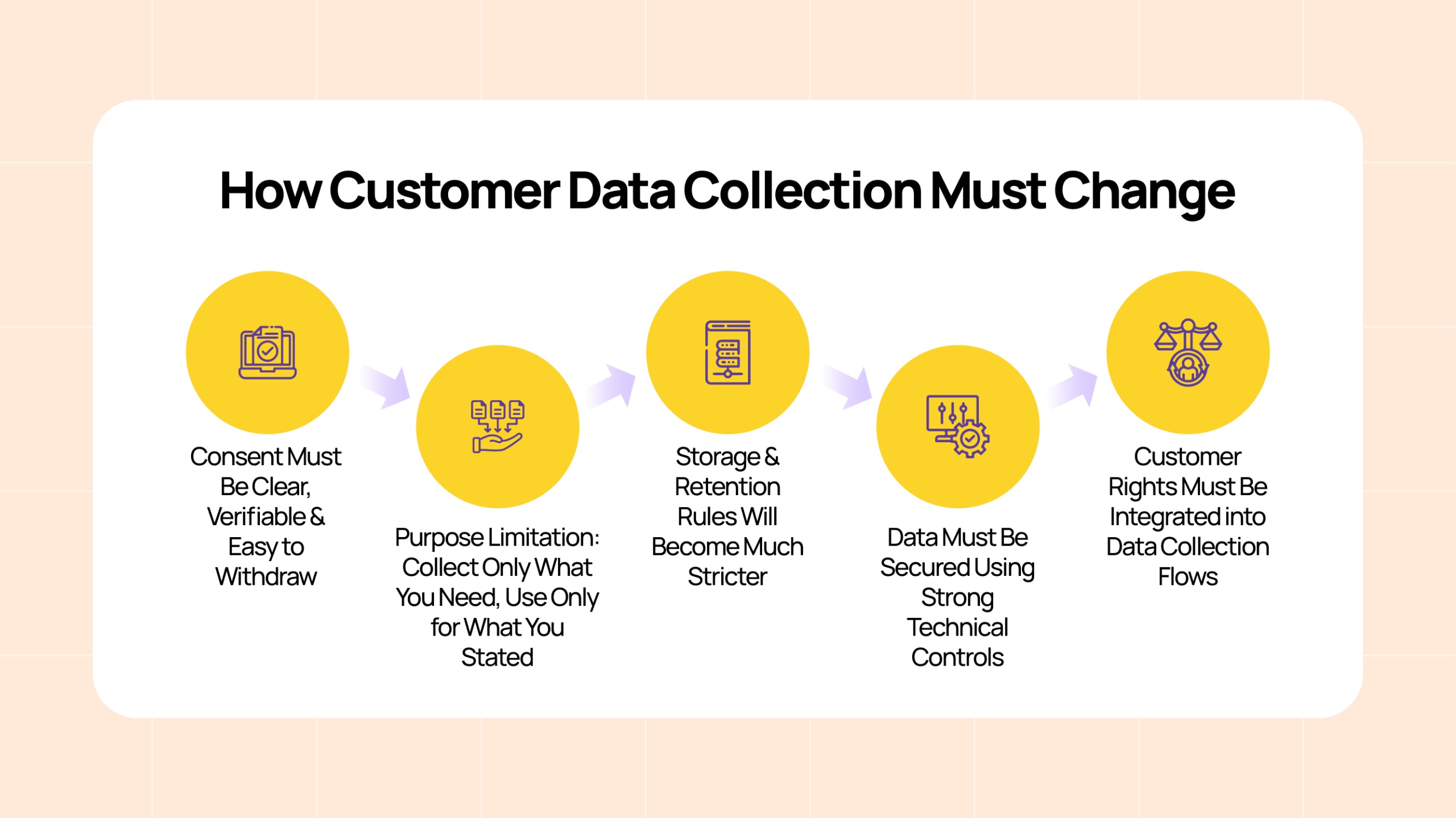
How Customer Data Collection Must Change (Consent, Purpose, Storage)
The DPDP Act and the 2025 Rules introduce a strict, clarity-first structure for how personal data must be collected, stored, and used. For Retail and F&B brands, the way data is captured will need a fundamental reset.
Here’s how your data collection practices must evolve:
1. Consent Must Be Clear, Verifiable & Easy to Withdraw
The DPDP Rules make it mandatory that customers give specific, informed, and itemized consent before their personal data is collected or used. Brands must now:
- Present data notices in clear, plain language with no hidden details.
- Clearly list what data is being collected (e.g., mobile number, birthday, order details).
- Clearly state why it’s being collected, whether for billing, loyalty points, personalized offers, or service fulfillment.
Provide customers with an easy mechanism to withdraw consent, and the withdrawal must be as easy as giving consent.
For Retail & F&B, this means consent prompts at POS, website forms, reservation systems, WhatsApp opt-ins, and loyalty program enrolments must be redesigned with full transparency.
Verifiable consent is essential, especially when collecting data of children or when identity verification is required. This includes mechanisms like:
- Reliable identity details
- Virtual tokens
- Digital logs of consent
2. Purpose Limitation: Collect Only What You Need, Use Only for What You Stated
The DPDP framework stresses strict purpose limitation, meaning brands must collect only the data necessary for delivering a service, not everything they might need later.
The Rules specifically require that notices must include:
- A detailed, itemized purpose for each data point
- A description of the goods or services linked to that purpose
For example:
- If you collect a customer’s birthday, you must specify that it is being used for birthday rewards or personalized communication.
- If you collect a phone number, you must specify if it is for order updates, loyalty identification, or marketing.
- You cannot use data for a new purpose later without fresh consent.
For brands, this means:
- No more blanket “data grabs.”
- Every data field must be justified, documented, and communicated.
- CRM workflows must be updated to respect declared purposes.
3. Storage & Retention Rules Will Become Much Stricter
Data cannot be stored forever. It must be deleted when the purpose is fulfilled or when the customer has not interacted within a defined period.
Key requirements include:
a) Mandatory Data Erasure After Inactivity
For certain large online platforms (like big e-commerce/social media platforms), data must be erased if the user has not interacted for about 3 years.
For other businesses, there’s no fixed number, but you still must not keep data longer than necessary for the purpose.
b) 48-hour Notification Before Erasure
For certain large online platforms covered by the Third Schedule Rule 8 in the DPDP Act 2025, the brand must notify the customer at least 48 hours before automatic erasure due to inactivity.
Smaller Retail/F&B players are not explicitly bound by this 48-hour rule, but can adopt similar practices as a good-faith measure.
c) Storage of Logs Only for One Year
You must retain certain logs and related personal data for at least one year for security and investigation purposes, and then erase them unless they need to be kept longer to comply with some other law or government order
d) Consent Records Must Be Stored for Seven Years
- Consent logs for at least seven years
If you use a registered Consent Manager (or act as one), consent logs must be kept for at least seven years. For other Data Fiduciaries, the Act still expects you to maintain records that can prove valid consent and notices, but it doesn’t fix a universal ‘7-year’ period.
4. Data Must Be Secured Using Strong Technical Controls
These include:
- Encryption, masking, and tokenization
- Strong access controls for both brand employees and third-party processors
- Log monitoring, unauthorized access detection, and investigation
- Storage of access logs and personal data only for limited durations
5. Customer Rights Must Be Integrated into Data Collection Flows
The DPDP Rules require brands to enable customers to:
- Access their data
- Correct their data
- Withdraw consent
- Request erasure
As stated in the Empowering Data Principals section on page 8, businesses must:
- Publish clear workflows for exercising these rights
- Respond to grievances within 90 days
This will require Retail & F&B brands to build or adopt systems that can quickly respond to customer data requests, especially within CRM environments.
What happens if brands don’t comply?
Depending on the type of violation, companies can face penalties up to ₹250 crore per violation (e.g., for failing to maintain reasonable security safeguards), up to ₹200 crore for breach-notification failures or violations relating to children, and up to ₹50 crore for other contraventions.
The message is clear: data protection is no longer optional; it’s a core business responsibility.
Conclusion
The DPDP Rules 2025 are a quiet but powerful shift in how Retail and F&B brands must think about customer data. For an industry built on relationships, this law pushes every brand to move from “collect everything” to “collect responsibly,” and from “use data because we can” to “use data because we should.”
And that’s a good thing.
When customers know their data is treated with respect, they trust you more. They share more. They come back more. Compliance, in that sense, isn’t a checkbox, it’s an opportunity to strengthen the connection you already rely on.
By tightening consent flows, cleaning up data practices, setting up better safeguards, and giving customers more control brands can turn DPDP into a competitive advantage rather than a compliance headache. The future belongs to businesses that make privacy part of the experience, not an afterthought.
Read more : Parameter of the Week: Days Since Last Visit