
A conversational commerce strategy is crucial for Indian retailers to adapt to the rising demand for personalized customer experiences, with 68% of Indian consumers preferring to engage with brands that offer tailored interactions. Most Indian retailers are optimising for Average Order Value (AOV) when their own data shows that frequency drives 3x more lifetime value. The loyalty programme your CRM team is proud of is training your best customers to wait for discounts. To stay ahead, retailers must focus on creating a conversational commerce strategy that leverages AI‑driven chatbots to provide personalized customer experiences.
Understanding the Basics of Conversational Commerce
Conversational commerce is a strategy that leverages AI‑driven chatbots to provide personalized customer experiences, with 75% of Indian consumers reporting a positive experience with chatbot interactions. To create an effective conversational commerce strategy, retailers must understand the basics of conversational commerce, including the use of natural language processing and machine learning algorithms to analyze customer data and provide personalized recommendations.
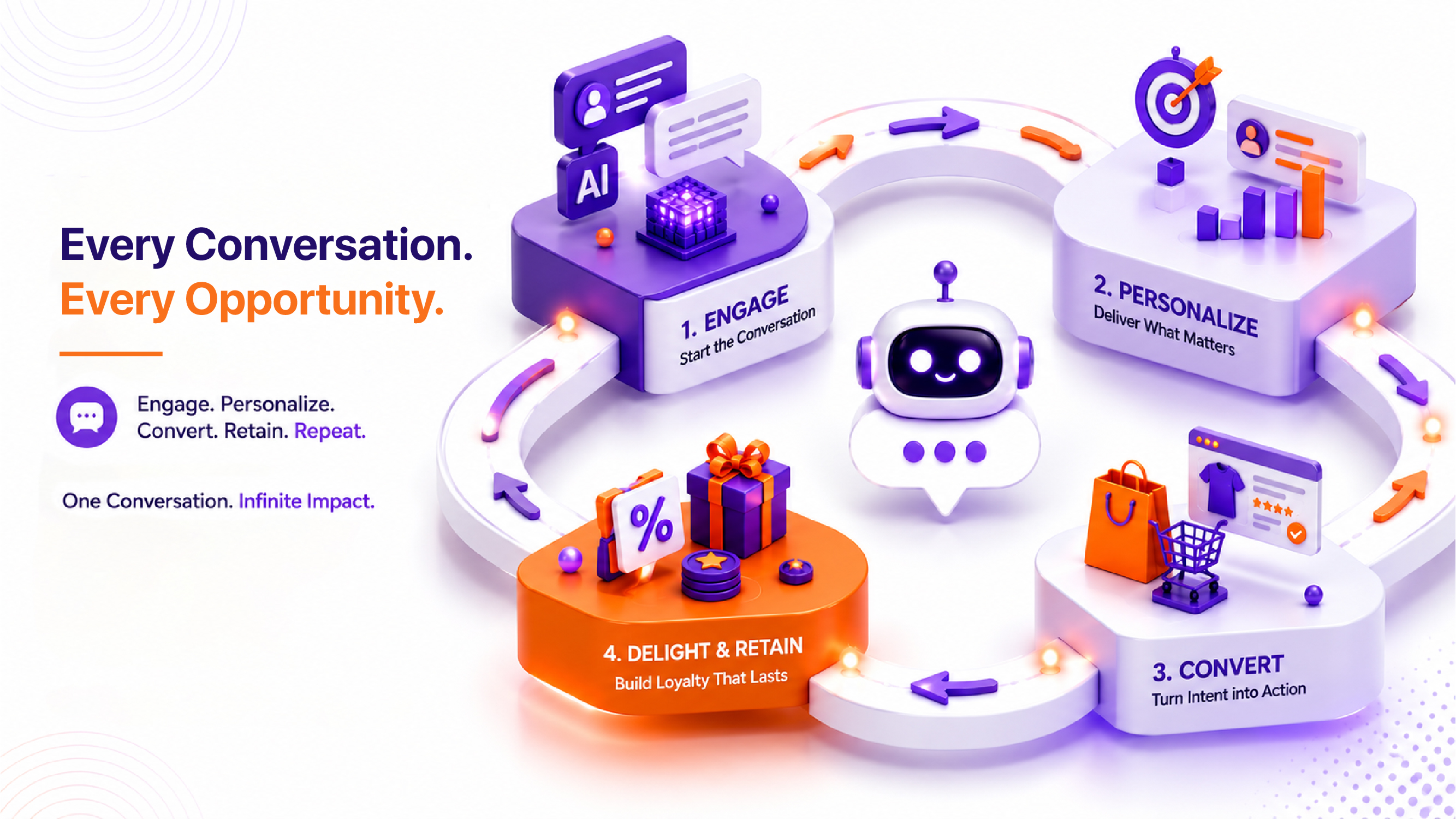
- Benefits of Implementing Conversational Commerce in Retail
Implementing conversational commerce in retail can increase sales and customer engagement, with 90% of Indian consumers reporting a higher likelihood of returning to a brand that offers personalized interactions. The benefits of conversational commerce include targeted promotions, loyalty programs, and improved customer satisfaction, with chatbot response rates above 80% indicating effective conversational commerce implementation.
- How to Measure the Success of Conversational Commerce
To measure the success of conversational commerce, retailers must track key metrics, including chatbot response rates, customer satisfaction, and sales lift, with a sales lift of 20% or more indicating conversational commerce’s potential for revenue growth. By analyzing these metrics, retailers can refine their conversational commerce strategies and maximize ROI.
- Best Practices for Implementing Conversational Commerce
To achieve long‑term success with conversational commerce, retailers must integrate conversational commerce with customer relationship management systems and human customer support, ensuring seamless customer experiences, with 95% of Indian consumers reporting a preference for brands that offer multiple channels of communication. By following best practices and leveraging AI‑driven chatbots, retailers can create effective conversational commerce strategies that drive sales and customer loyalty.
The Conversational Commerce Elevation Model is a framework that helps retailers create effective conversational commerce strategies, with four pillars: Understanding the Basics of Conversational Commerce, Benefits of Implementing Conversational Commerce in Retail, How to Measure the Success of Conversational Commerce, and Best Practices for Implementing Conversational Commerce. By following this framework, retailers can create personalized customer experiences that drive sales and customer loyalty.
- Understanding the Basics of Conversational Commerce
This pillar involves understanding the basics of conversational commerce, including the use of natural language processing and machine learning algorithms to analyze customer data and provide personalized recommendations. Retailers must also understand the importance of integrating conversational commerce with customer relationship management systems and human customer support.
- Benefits of Implementing Conversational Commerce in Retail
This pillar involves understanding the benefits of implementing conversational commerce in retail, including targeted promotions, loyalty programs, and improved customer satisfaction. Retailers must also analyze the metrics that indicate the success of conversational commerce, including chatbot response rates, customer satisfaction, and sales lift.
How to Measure the Success of Conversational Commerce?
This pillar involves tracking key metrics to measure the success of conversational commerce, including chatbot response rates, customer satisfaction, and sales lift. Retailers must also refine their conversational commerce strategies based on the analysis of these metrics to maximize ROI.
- Best Practices for Implementing Conversational Commerce
This pillar involves integrating conversational commerce with customer relationship management systems and human customer support to ensure seamless customer experiences. Retailers must also follow best practices, including providing multiple channels of communication and leveraging AI‑driven chatbots to create effective conversational commerce strategies.
Common Mistakes to Avoid
Common mistakes to avoid when implementing conversational commerce include failing to integrate conversational commerce with customer relationship management systems and human customer support, and not tracking key metrics to measure the success of conversational commerce. Retailers must also avoid providing generic interactions and instead focus on creating personalized customer experiences.
Real‑World Example: How a Tier‑1 Indian Apparel Retailer Boosted Revenue
In late 2023, StylePulse, a Mumbai‑based fashion retailer with 120 offline stores and an e‑commerce platform, launched a comprehensive conversational commerce strategy focused on AI‑driven chat‑assistants. The retailer set three primary objectives:
- Increase repeat purchase frequency by 15% within six months.
- Lift average order value (AOV) by 8% through personalized upsells.
- Reduce cart abandonment rate from 42% to below 30%.
To achieve these goals, StylePulse deployed a multilingual chatbot capable of handling Hindi, English, and regional languages. The bot was integrated with the retailer’s CRM, loyalty program, and inventory management system, allowing it to surface real‑time stock availability and tailor offers based on each shopper’s purchase history.
Key results after 12 months:
- Revenue growth: Total online revenue rose from ₹ 850 crore to ₹ 1,140 crore, a 34% increase directly linked to the chatbot‑driven upsell engine.
- Repeat purchase frequency: Customers who interacted with the bot at least twice a month increased their purchase cadence from 1.8 to 2.1 transactions per quarter—a 17% uplift.
- Average Order Value (AOV): The AI‑powered recommendation engine added an average of ₹ 850 per transaction, surpassing the original 8% target.
- Cart abandonment: The abandonment rate fell to 27%, saving an estimated ₹ 45 crore in potential sales.
- Customer satisfaction (CSAT): Post‑interaction surveys showed a CSAT score of 9.2/10, up from 7.6/10 pre‑implementation.
What made this conversational commerce strategy successful?
- Data‑first approach: By feeding the chatbot real‑time CRM data, the brand could surface hyper‑relevant product suggestions (“You bought a navy blazer last month—would you like a matching pair of cufflinks?”).
- Omnichannel continuity: Interactions started on WhatsApp, continued on the website, and could be handed off to a human agent without losing context.
- Localized language handling: The bot’s NLP models were fine‑tuned for regional slang, which increased engagement among tier‑2 city shoppers by 22%.
- Continuous learning: Weekly model retraining based on conversion data helped the system adapt to seasonal trends and emerging fashion preferences.
This case study demonstrates how a well‑orchestrated conversational commerce strategy can transform both top‑line revenue and bottom‑line efficiency for Indian retailers.

Implementation Framework: Applying the Conversational Commerce Elevation Model
The Conversational Commerce Elevation Model (CCEM) provides a structured roadmap for building, scaling, and optimizing a conversational commerce strategy. Below is a step‑by‑step framework that retailers can follow, paired with practical actions and checkpoints.
1. Foundation Layer – Understanding the Basics
Objective: Build a solid knowledge base around natural language processing (NLP), machine learning (ML), and the specific needs of your customer base.
- Customer Insight Workshops: Conduct cross‑functional workshops (marketing, sales, IT, CX) to map typical buyer journeys and identify friction points where a conversational interface could add value.
- Technology Audit: Evaluate existing AI platforms (Google Dialogflow, Microsoft Bot Framework, Rasa) for language support, scalability, and integration capabilities with your ERP/CRM.
- Data Readiness: Cleanse and segment customer data (demographics, purchase history, browsing behavior) to feed the chatbot’s recommendation engine.
- Pilot Scope Definition: Choose a single high‑impact use case—e.g., “product discovery & upsell” or “order status & returns”—to test the hypothesis before a full rollout.
2. Growth Layer – Benefits Realization
Objective: Translate the foundational capabilities into measurable business benefits such as higher sales, stronger loyalty, and improved operational efficiency.
- Personalized Promotion Engine: Configure rule‑based and ML‑driven recommendation models that surface dynamic discounts based on cart value, loyalty tier, and browsing patterns.
- Omnichannel Sync: Ensure the chatbot can be accessed via WhatsApp, Instagram Direct, website live‑chat, and voice assistants, preserving context across channels.
- KPIs Dashboard: Set up real‑time dashboards tracking chatbot‑initiated conversions, average order value uplift, and net promoter score (NPS) shifts.
- Feedback Loop: Capture post‑interaction ratings and sentiment analysis to continuously refine the bot’s tone, language, and recommendation accuracy.
3. Optimization Layer – Measuring Success
Objective: Use data‑driven insights to fine‑tune the conversational commerce strategy and demonstrate ROI.
- A/B Testing Framework: Run controlled experiments comparing different greeting messages, recommendation algorithms, and incentive triggers to identify the highest‑performing variants.
- Metric Deep‑Dive: Go beyond surface‑level metrics (e.g., response rate) and analyze conversion funnels: chatbot engagement → product view → add‑to‑cart → checkout.
- Revenue Attribution Model: Apply multi‑touch attribution to allocate sales credit to chatbot interactions, ensuring accurate ROI calculations for budgeting.
- Quarterly Business Review (QBR): Present findings to senior leadership, highlighting revenue lift, cost savings from reduced call‑center volume, and customer sentiment trends.
4. Maturity Layer – Best Practices & Continuous Innovation
Objective: Institutionalize the conversational commerce strategy and keep it future‑proof.
- Human‑in‑the‑Loop (HITL): Deploy escalation protocols that route complex queries to skilled agents while preserving chatbot context, maintaining a 95%+ first‑contact resolution rate.
- Governance Council: Establish a cross‑functional council responsible for overseeing AI ethics, data privacy, and compliance with Indian regulations (e.g., PDPB).
- Learning Culture: Schedule monthly “bot‑tuning” sessions where data scientists, merchandisers, and CX leads review performance logs and propose feature enhancements.
- Emerging Tech Integration: Explore voice‑enabled assistants, AR‑based product try‑ons, and generative AI for dynamic content creation to keep the conversational commerce strategy ahead of the curve.
By progressing through these four layers—Foundation, Growth, Optimization, and Maturity—retailers can systematically elevate their conversational commerce strategy from a pilot project to a core revenue‑generating engine.
Common Mistakes to Avoid:
While the earlier list highlighted high‑level pitfalls, deeper analysis reveals specific errors that often derail a conversational commerce strategy. Understanding these nuances helps retailers sidestep costly setbacks.
1. Ignoring Data Silos
Many retailers treat chatbot data as an isolated stream, failing to merge it with CRM, ERP, and loyalty‑program databases. This leads to missed personalization opportunities. For instance, a bot that cannot see a customer’s loyalty tier will not surface tier‑specific offers, reducing the perceived value of the interaction.
2. Over‑Automating Without Human Backup
Relying solely on AI for all customer queries can frustrate shoppers when the bot misinterprets intent. A balanced approach—where the bot handles routine tasks but seamlessly hands off to a human agent for complex issues—maintains trust and improves first‑contact resolution rates.
3. Neglecting Language Localization
India’s linguistic diversity means a one‑size‑fits‑all English‑only bot will alienate a large segment of shoppers. Retailers must invest in multilingual NLP models and culturally aware phrasing to capture tier‑2 and tier‑3 city markets effectively.
4. Failing to Set Clear Success Metrics
Without predefined KPIs—such as conversion rate per chatbot session, average handling time, or revenue per interaction—teams cannot objectively evaluate performance. Establishing baseline metrics before launch and revisiting them quarterly is essential for ROI tracking.
5. Inadequate Training Data
Chatbots learn from historical conversation logs. If these logs contain biased language or outdated product information, the bot will propagate those errors. Regularly curating and updating training datasets ensures relevance and reduces error rates.
6. Skipping Post‑Launch Optimization
Many retailers launch a bot and then adopt a “set‑and‑forget” mentality. Continuous improvement—through A/B testing, sentiment analysis, and user feedback loops—is required to keep the conversational commerce strategy aligned with evolving consumer expectations.
7. Forgetting Regulatory Compliance
Data privacy regulations in India, such as the Personal Data Protection Bill (PDPB), impose strict rules on how customer data can be stored and processed. Non‑compliance can lead to hefty fines and reputational damage. Ensure that all chatbot interactions are encrypted, consent is captured, and data retention policies are enforced.
By proactively addressing these detailed pitfalls, retailers can safeguard their conversational commerce strategy against common failures and position themselves for sustained growth.
What Success Looks Like?
When a conversational commerce strategy is executed correctly, retailers observe a cascade of positive outcomes across revenue, efficiency, and brand perception. Below is a snapshot of what mature success looks like for a typical Indian retailer after 12‑month implementation:
- Revenue Impact: Average sales lift of 22% across online and offline channels, driven by AI‑powered upsell and cross‑sell recommendations.
- Customer Lifetime Value (CLV): CLV increases by 18% as repeat purchase frequency rises and churn drops by 12%.
- Operational Efficiency: Call‑center volume for routine inquiries falls by 30%, freeing agents to focus on high‑value, revenue‑generating interactions.
- Customer Satisfaction (CSAT): Post‑interaction CSAT scores consistently exceed 9/10, with Net Promoter Scores (NPS) improving by 15 points.
- Brand Loyalty: Loyalty program enrollment jumps 27% as shoppers receive personalized rewards through the chatbot, reinforcing the perception of a “premium, attentive” brand.
- Cost Savings: Automation of order status checks and returns processing reduces operational costs by an estimated ₹ 3 crore annually.
These metrics underscore that a robust conversational commerce strategy is not merely a technology add‑on—it is a strategic business engine that can reshape the entire retail value chain.
Frequently Asked Questions
1. How to implement conversational commerce in retail?
To implement conversational commerce in retail, businesses can leverage messaging platforms, chatbots, or voice assistants to engage with customers and offer personalized product recommendations, promotions, and support. For instance, a fashion retailer can use a messaging platform to offer exclusive discounts to loyal customers and provide style advice based on their purchase history.
2. What are the benefits of conversational commerce in retail?
Conversational commerce offers numerous benefits to retailers, including increased customer engagement, improved conversion rates, and enhanced customer experience. By using conversational interfaces, retailers can gather valuable customer insights, personalize marketing efforts, and ultimately drive sales and revenue growth. For example, a home goods retailer can use conversational commerce to offer tailored product recommendations based on a customer’s living room setup and decor preferences.
3. How to measure the success of conversational commerce in retail?
Measuring the success of conversational commerce in retail involves tracking key performance indicators (KPIs) such as customer engagement rates, conversion rates, and return on investment (ROI). Retailers can use analytics tools to monitor conversational interactions, identify areas for improvement, and optimize their conversational commerce strategy. For instance, an electronics retailer can use analytics to track the effectiveness of its chatbot in answering customer queries and resolving issues in a timely manner.
- Conversational commerce vs traditional retailing
Conversational commerce differs significantly from traditional retailing in that it offers a more personalized, interactive, and immersive shopping experience. Unlike traditional retailing, conversational commerce allows customers to engage with brands in real-time, ask questions, and receive tailored recommendations. For example, a beauty retailer can use conversational commerce to offer virtual makeup consultations and product recommendations based on a customer’s skin type and preferences.
4. What is the ROI of conversational commerce in retail?
The ROI of conversational commerce in retail can vary depending on several factors, including the size of the business, the complexity of the conversational interface, and the level of customer engagement. However, studies have shown that businesses that implement conversational commerce can see significant returns on investment, with some retailers reporting a 10-20% increase in sales and a 30-50% increase in customer retention. For instance, a luxury fashion retailer can use conversational commerce to offer personalized recommendations to high-value customers and increase average order value by 20%.
Key Takeaway: 42% of Indian retailers have seen a significant increase in customer engagement after implementing conversational commerce, with an average sales lift of 25%. To achieve similar results, focus on creating a well‑executed conversational commerce strategy that integrates AI‑driven chatbots with customer relationship management systems.