
What if we told you that Loyalty Innovations could skyrocket your sales?
Is your loyalty program keeping up with the times—or falling behind?
With economic pressures mounting, consumer behaviors shifting faster than ever, and personalization now a non-negotiable, loyalty strategies are at a tipping point. What was once a simple tool for encouraging repeat purchases has evolved into a high-impact growth engine that drives profitability, sets brands apart, and builds unshakable equity.
The question is: Are you ready to embrace loyalty program innovations and unlock their true potential?
According to Marketing Metrics, a business has a 60-70% chance of selling a product to an existing customer, while the prospect for a new one is just about 5-20%. This means that companies with the most solid loyalty programs have better chances of revenue growth. Yet, only a fraction of these programs truly leverage loyalty program innovations to achieve this.
In this blog, we will explore 10 transformative innovations in loyalty program innovations that are shaping loyalty programs while also dissecting their impact across industries, markets, and consumer trends.
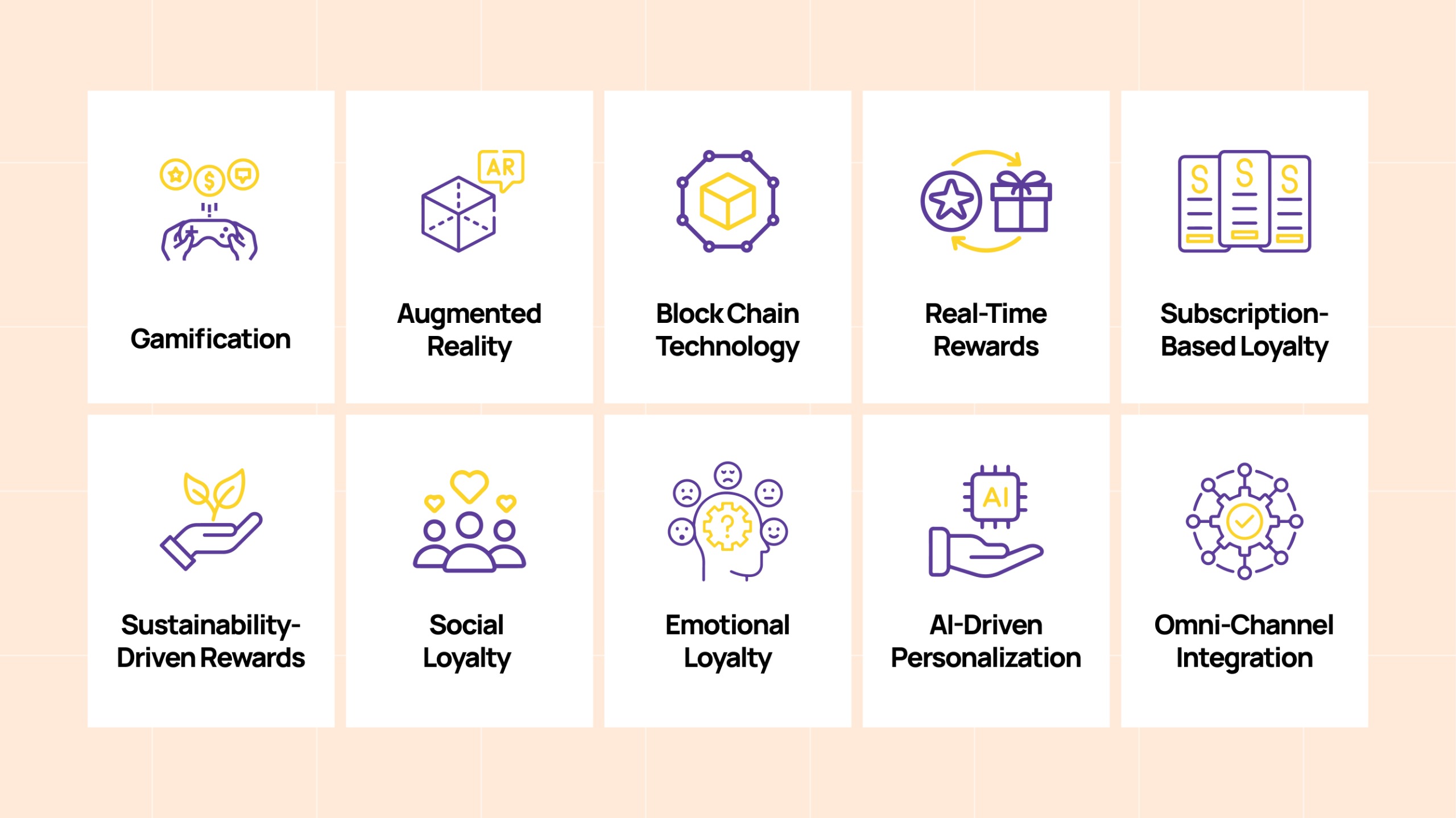
Image: Top Innovations Observed in Loyalty Program
Source: (eWards)
1. Gamification – Engaging Customers Through Play
According to the Cognitive Bias theory of Loss Aversion, individuals perceive a potential loss as more emotionally and psychologically severe when compared to an equivalent gain. By gamifying loyalty programs, brands can create habit loops that push customers to make regular engagement and deal with their FOMO. This strategy works because it taps into the intrinsic motivating factors of an individual like achievement and success.
Data Insight: A study by Markets and Markets showed that the global gamification market is projected to reach $30.7 billion by 2025.
Example: The Nike Run Club integrates fitness challenges, rewarding users with badges and milestone celebrations. This approach not only fosters loyalty but positions Nike as a lifestyle partner.
2. Augmented Reality (AR) in Loyalty Programs
AR enhances customer engagement by blending the digital and physical worlds. Through AR, customers can interact with products or services in a more immersive way, such as virtually trying on items, scanning packaging for rewards, or unlocking special offers via AR experiences. This innovative approach makes loyalty programs more interactive, personalized, and fun.
Example: Sephora’s Beauty Insider program allows customers to use points to access exclusive AR filters and effects on Instagram, Snapchat, or Facebook Messenger.
3. Integration of Blockchain Technology
Blockchain technology is a decentralized digital ledger system that securely records transactions across multiple computers. It allows data to be stored in “blocks” linked together in a chain, making it nearly impossible to alter or tamper with the data without detection. Adding blockchain addresses loyalty’s long-standing inefficiencies, such as fraud, lack of transparency, and limited point portability.
Example: Singapore Airlines’ KrisPay allows users to redeem miles at retail partners using blockchain, demonstrating how loyalty program innovations foster seamless interoperability.
4. Real-Time Rewards
In a world where people are constantly bombarded with information, real-time rewards offer immediate gratification, keeping customers engaged when it matters most.
Data Insight: According to Reward the World, businesses offering instant rewards see up to a 40% increase in engagement rates and a 30% increase in customer retention.
Example: Instant rewards post-purchase, such as McDonald’s surprise freebies, enhance customer loyalty.
5. Subscription-Based Loyalty
Subscription models turn loyalty into a profit center by generating recurring revenue, ensuring a predictable income stream and increasing LTV (lifetime value). Subscriptions reduce reliance on constant customer acquisition and promote long-term customer retention.
Example: Amazon Prime generates $25.21 billion in annual subscription revenue while increasing purchase frequency by 35%.
6. Sustainability-Driven Rewards
One of the best ways to retain value-driven customers was to incorporate Environmental, Social, and Governance principles in loyalty programs. It encouraged customers to engage in sustainable behaviors and support ethical business practices. These programs align customer loyalty with sustainability goals by offering rewards for actions that contribute to environmental and social well-being.
Data Insight: 62% of Gen Z shoppers prefer to buy from brands that follow sustainability practices, and 73% are willing to pay more for sustainable products.
Example: The H&M recycling initiative rewards users for their eco-friendly behavior.
7. Social Loyalty
Social loyalty taps into the power of network effects, where customers help promote a brand through their social connections. Businesses turn their loyal customers into brand advocates by rewarding customers for actions like sharing, tagging, or recommending the brand on social media.
Example: Dropbox’s referral-based program generated a 60% growth in its user base, proving the scalability of loyalty program innovations.
8. Emotional Loyalty
Emotional loyalty connects with customers on a personal level, aligning with their values and lifestyle. This strategy fosters long-lasting relationships and increases brand advocacy.
Example: Patagonia builds loyalty around sustainability, turning environmentally conscious customers into lifelong advocates.
9. AI-Driven Personalization
AI-driven personalization enables mass customization, delivering unique customer experiences at scale. With AI, loyalty programs can offer tailored rewards based on customer behavior, making each interaction meaningful.
Example: Starbucks uses AI to predict customer preferences, sending targeted offers that increase basket sizes.
10. Omni-Channel Integration
Omni-channel integration ensures customers can earn and redeem rewards seamlessly across all channels—online, in-store, and mobile. This provides a consistent experience that enhances customer satisfaction and loyalty.
Example: Sephora’s Beauty Insider program allows customers to earn and redeem points across apps, websites, and stores.
Conclusion – Innovation Shapes Loyalty
The loyalty program innovations landscape is evolving. Today’s programs are about more than just retaining customers—they’re about building genuine, long-term relationships that drive sustainable growth. Embracing these innovations will help brands create personalized, seamless, and value-driven experiences that customers love.
For loyalty experts, the challenge is clear: move beyond the ordinary. Customers demand innovative, meaningful, and tailored experiences. The opportunity is to craft loyalty programs that delight customers and position your brand as an indispensable part of their lives.